Blog / Comparison

The 2024 Lexus NX vs. The Lexus RX

Lexus NX vs Lexus RX

Are you considering buying a Lexus SUV? If so, you've probably been trying to decide between the Lexus NX and Lexus RX. The NX and RX are exceptionally well-built crossovers that deliver outstanding reliability, refinement, comfort, and technology, which are the hallmarks of Lexus vehicles. While they're similar in many ways, they also have differences that set them apart. Read below as our Lexus of Stevens Creek team in San Jose, California, makes a detailed comparison between the Lexus NX and Lexus RX to help you determine which one fits you better.

Trim Levels and Prices

The Lexus NX and Lexus RX are highly customizable vehicles, but the RX gives you more options with its extensive 10-trim lineup. Both models offer all-wheel-drive (AWD) options. The NX is available in six variants: the entry-level 250, 350 AWD, 350 F Sport Handling AWD, 350h AWD, 450h+ AWD, and the range-topping 450h+ F Sport Handling AWD. Note that the "h" designation indicates a hybrid model. One of the main advantages of the NX is that it's more affordable than the RX. Its starting MSRP ranges from $40,305 for the 250 to $60,655 for the 450h+ F Sport Handling AWD.

The trim levels of the RX are the base 350, 350h AWD, 350 Premium, 350h Premium AWD, 350 Premium+, 350h Premium+ AWD, 350 Luxury, 350h Luxury AWD, 350 F Sport Handling AWD, and the top-spec 500h F Sport Performance AWD. The 350 starts at $48,950, while the 500h F Sport Performance AWD costs at least $63,150.

Exterior

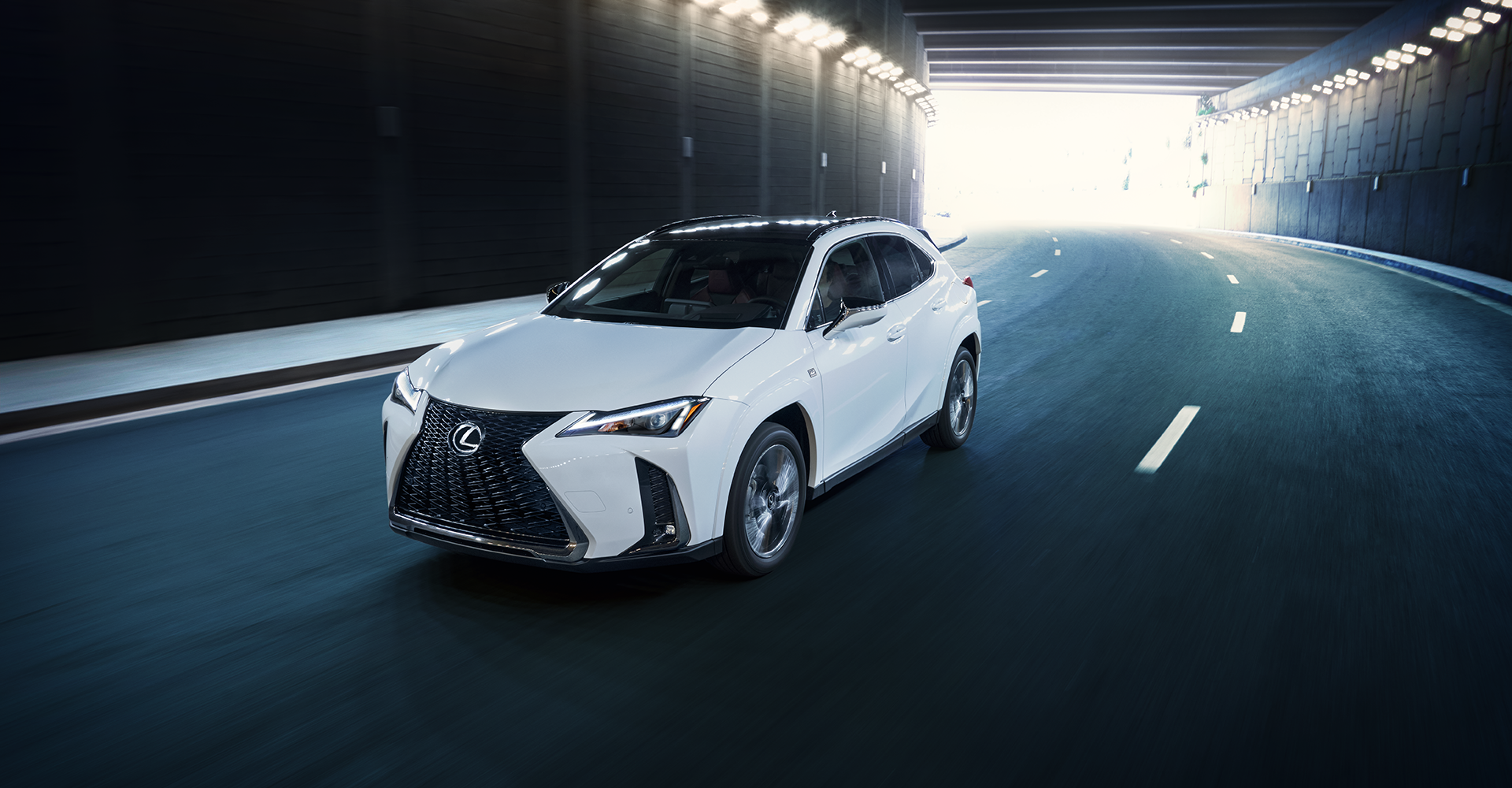
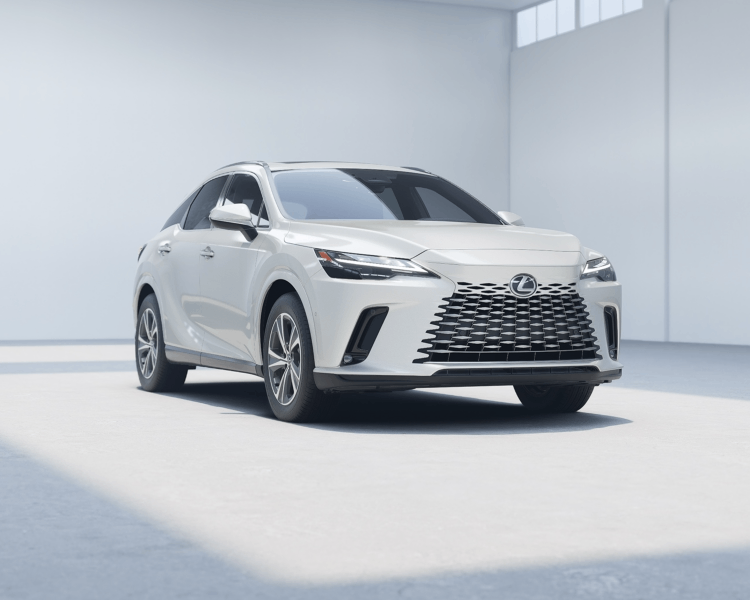
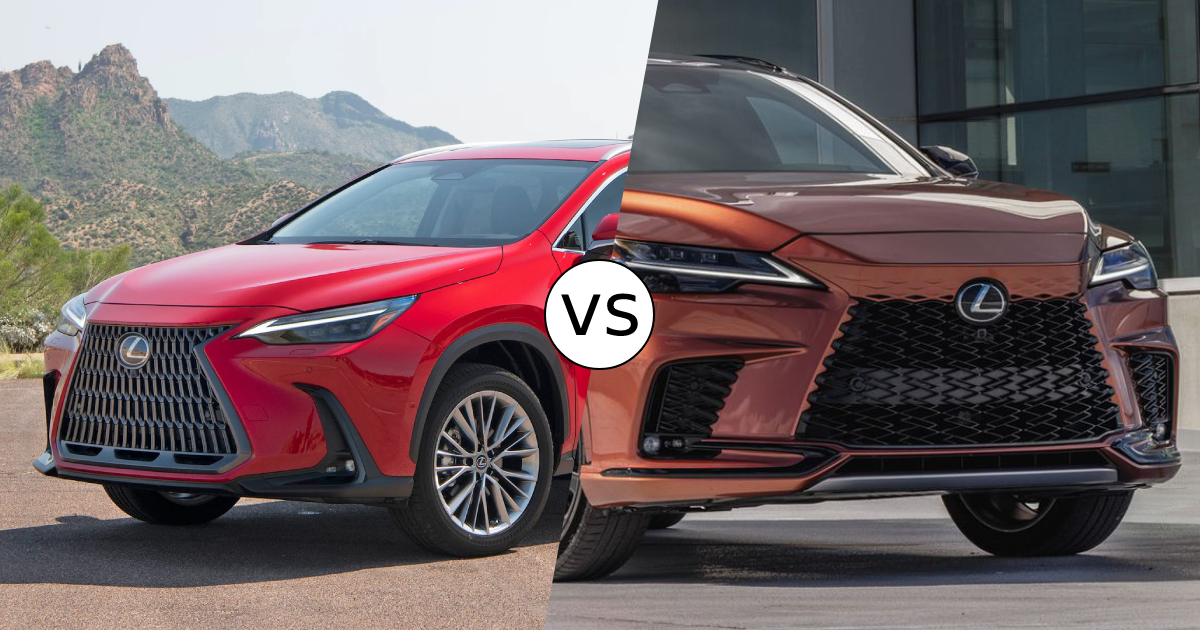
The most obvious difference between the Lexus NX and the Lexus RX is their size. The NX is a compact SUV, while the RX competes in the midsize category. The two SUVs share many similarities in exterior styling, including a ridged hood, squinting headlights, and a sloping roofline. But the NX looks bolder and more aggressive with its upright front end and massive, hourglass-shaped grille. In contrast, the RX features a trapezoidal grille and an elongated hood that dips down to the Lexus badge, giving it a sleeker and more elegant appearance.

Performance

There are four powertrains to choose from if you decide to get the Lexus NX. You can equip gas-powered models with either the standard 203-horsepower 2.5-liter four-cylinder or a 275-horsepower 2.4-liter turbo-four. Both engines mate to a slick-shifting eight-speed automatic transmission. The hybrid models use a continuously variable transmission and get their power from a 2.5-liter four-cylinder engine that combines with two electric motors. The 350h can generate 240 horsepower, whereas the 450h+ uses a plug-in-hybrid setup rated at 304 horsepower.

The Lexus RX 350 comes standard with the NX's optional 2.4-liter turbo-four, which also pairs with an eight-speed automatic transmission. Lower-trim hybrid variants have a 246-horsepower powertrain that combines a 2.5-liter four-cylinder engine with two electric motors and a continuously variable transmission. For quicker acceleration and a more engaging driving experience, go for the 500h F Sport Performance AWD. With a turbo-four engine, two electric motors, and a six-speed automatic transmission, the top-tier trim puts out an impressive 366 horsepower.

Handling

Both the Lexus NX and Lexus RX are a pleasure to drive, thanks to their light, responsive steering and composed handling. But the NX may be a better choice if you're an urban commuter in San Jose, as its smaller dimensions make it easier to maneuver in congested traffic and parking lots. It's also a remarkably agile vehicle that tackles corners and twisty roads with aplomb.

In contrast, the RX does a better job of absorbing bumps, potholes, and other uneven surfaces, resulting in a smooth and comfortable ride. Then again, it can satisfy even the most discerning driving enthusiasts in F Sport Performance guise.

Interior

Whether you choose the Lexus NX or Lexus RX, you'll be thrilled with its sumptuous interior. Both models' cabins feature immaculate fit and finish, aesthetically pleasing accents, and an abundance of premium materials and soft-touch elements. They're both delightful places to spend time.

The two Lexus SUVs also offer well-padded and supportive seats to keep you and your passengers comfortable and relaxed even after hours of driving. But if you routinely drive around with multiple passengers or need to carry a lot of cargo, you'd be better off getting the RX. As a midsize SUV, it provides more passenger and cargo space than its compact sibling.

Features

Like other new Lexus vehicles, the NX and RX have a long list of infotainment features to make your trips more convenient and enjoyable. They come standard with a 9.8-inch touch-screen display, a Wi-Fi hotspot, HD radio, wireless Android Auto and Apple CarPlay, and USB ports. If you want a better in-vehicle experience, you can get the optional 14-inch touch-screen display. The RX has the upper hand over the NX in the technology department, as it offers more USB ports and better audio systems.

When it comes to driver assistance features, the NX and RX are among the leaders in their respective segments. Their standard offerings include forward collision alert, pedestrian alert, forward automated emergency braking, traffic sign recognition, automated high-beam headlamps, adaptive cruise control, lane departure alert, lane-keeping assistance, and safe-exit assistance. For enhanced protection, you can opt for available upgrades, such as front and rear parking sensors, parking assistance, a head-up display, and a 360-degree parking camera system. Blind-spot detection and rear cross-traffic alerts are standard in the NX and optional in the RX.

Test-Drive the Lexus NX and Lexus RX at Lexus of Stevens Creek

The best way to determine whether the Lexus NX or Lexus RX is more suitable for you is to test-drive them. If you live in San Jose, California, consider stopping by Lexus of Stevens Creek to check out these two amazing crossovers. Serving San Jose, Los Gatos, Mountain View, Milpitas, Morgan Hill, Palo Alto, and Fremont, our dealership can help you purchase a Lexus SUV that perfectly suits your taste and lifestyle. We also offer great financing deals and awesome discounts to ensure you'll drive away with maximum savings. Contact us today to schedule a test drive.
Posted in:

Related Posts

Lexus GX

Lexus GX vs. LX: Comparing Size, Space, and Dimensions

If you've been cross-shopping Lexus SUVs, you've probably asked the same question we hear constantly at our showroom: which one is actually bigger, the GX or the LX? Each model has its own strengths depending on how you plan to use it, and a few of the numbers might surprise you. You can browse our new Lexus GX and LX inventory to see both models side by side, but let's break down the real measurements first. Lexus GX vs. LX: Which Is Bigger? In terms of overall footprint, the LX is the larger vehicle, with a longer body and a wider cabin designed for flagship comfort. Size isn't a single number though, and the GX closes the gap in ways that matter for real driving situations. The GX actually leads in third-row legroom, maximum cargo volume, and towing capacity. That's the kind of detail a spec sheet reveals but a showroom floor doesn't always show at a glance. Here's a quick side-by-side look at how the two compare on the numbers that matter most. Spec Lexus GX 550 Lexus LX 600 / 700h Length 197.05 in. 200.2 – 200.59 in. Width (w/o mirrors) 77.95 – 78.74 in. 78.35 in. Height 75.39 – 77.17 in. 74.21 – 74.61 in. Wheelbase 112.2 in. 112.2 in. 2nd-Row Legroom 36.73 in. 36.61 in. (33.86 in. Ultra Luxury) 3rd-Row Legroom 37.89 in. 31.1 in. Max Cargo (3-row models) 76.9 cu. ft. 64.0 cu. ft. (LX 600) / 62.4 cu. ft. (LX 700h) Max Cargo (2-row models) 90.5 cu. ft. (Overtrail, Overtrail+) 71.0 cu. ft. (LX 600) / 62.6 cu. ft. (LX 700h) Exterior Dimensions Compared Length, Width, and Height The GX 550 measures 197.05 in. in length, while the LX stretches to 200.59 in. on most grades and 200.2 in. on F SPORT, giving it a slightly longer, more commanding stance. Width without mirrors is close between them: 77.95 in. on standard GX trims, widening to 78.74 in. on Overtrail and Overtrail+, versus 78.35 in. for the LX. Neither model has a dramatic advantage squeezing through narrow lanes. Height flips the script a bit. The GX stands taller, at 75.39 in. on standard trims and up to 77.17 in. on the Overtrail grades, compared to the LX at 74.21 to 74.61 in. depending on wheel and tire size. That comes down to the GX's more rugged, body-on-frame stance and its taller ride height. Wheelbase and Turning Radius Both SUVs share a 112.2 in. wheelbase, so ride stability on the highway is comparable between them. Turning circles are close as well, with both landing right around 39.4 ft. curb-to-curb, and the LX needing roughly 42.0 ft. wall-to-wall on its 22 in. wheel setup. For anyone dealing with tight San Jose garages or the tiered parking structures downtown, that similarity means neither model has a real edge in close-quarters maneuvering, though the GX's shorter overall length can help when backing into a compact space. Interior Space and Passenger Comfort Front and Second-Row Room Up front, the LX offers more shoulder and hip room, at 61.42 in. and 59.65 in. respectively, compared to the GX's 59.51 in. shoulder and 56.46 in. hip room. Front legroom is essentially a wash, 41.14 in. in the LX versus 41.18 in. in the GX. Second-row comfort is close too. The GX offers 43.15 in. of headroom and 36.73 in. of legroom, while the LX provides 38.98 in. of headroom and 36.61 in. of legroom. One exception worth knowing: the LX 700h Ultra Luxury swaps the standard bench for a four-seat second row with a reclining right-rear seat and ottoman. That configuration trades measured legroom, dropping to 33.86 in., for a level of comfort closer to what you would expect in a chauffeured sedan. Third-Row Seating Space GX third-row legroom measures 37.89 in., about 6.8 in. more than the LX's 31.1 in. For families doing regular third-row carpooling around the Bay Area, that's a meaningful difference for anyone riding back there on a regular basis. The GX seats up to seven passengers, and that legroom advantage makes those rear seats genuinely usable for adults, not just kids on short trips. Cargo Capacity: Behind the Third Row and Maximum Storage Cargo numbers depend heavily on configuration, so it helps to compare like for like. In three-row form, the LX 600 offers 11 cu. ft. behind the third row, about 44 cu. ft. with the third row folded, and roughly 64 cu. ft. with the second and third rows down. The three-row GX comes in at 10.3 cu. ft., 40.2 cu. ft., and 76.9 cu. ft. in those same configurations. Behind the third row the two are nearly identical, but with everything folded the GX opens up close to 13 cu. ft. more usable space. The hybrid gives up ground here. The LX 700h holds about 7.2 cu. ft. behind the third row and tops out near 62.4 cu. ft. with the rear rows folded, noticeably less than the LX 600. Two-row layouts widen the gap further. The GX Overtrail and Overtrail+ reach 45.6 cu. ft. behind the second row and a maximum of 90.5 cu. ft. with the seats folded. A two-row LX 600 offers about 46 cu. ft. with all seats up and a maximum of 71 cu. ft., while the two-row LX 700h maxes out around 62.6 cu. ft. If you are hauling gear for a trip to the lake or moving bulky equipment, the GX is the more accommodating of the two. Size vs. Capability: Towing and Payload The GX runs a 3.4L twin-turbo V6 producing 349 hp and 479 lb-ft of torque, with a maximum tow rating of 9,063 lbs. Ratings vary by grade and equipment, so confirm the number for the specific trim you are considering. The LX 600 uses the same twin-turbo V6 tuned to 409 hp and 479 lb-ft, and the LX 700h hybrid produces 457 hp and 583 lb-ft. Both are rated to tow 8,000 lbs. when equipped with the Towing Package. That leaves the GX with roughly a 1,000 lb. advantage at the top of its range, which matters if you are hitching a boat for a weekend on one of the local lakes or heading for trails outside Silicon Valley. Curb weight and GVWR differ as you would expect. The GX sits around 5,467 lbs. with a 6,920 lb. GVWR. The LX 600 ranges from 5,754 to 5,875 lbs. with a 7,230 lb. GVWR, and the heavier LX 700h runs 6,128 to 6,261 lbs. with a 7,450 lb. GVWR. Choosing the Right Size for Your Lifestyle The GX: Rugged Versatility in a Mid-Size Frame The GX is built for buyers who want real capability without stepping into flagship-size territory. Minimum ground clearance is 8.7 in. on standard trims and 9.84 in. on the Overtrail grades, which suits hillside driveways and unpaved trails around the region. Its power figures pair with towing and cargo numbers that hold up in practice rather than just on paper. Across the lineup, from the standard trims through the off-road-focused Overtrail and Overtrail+, the GX balances comfort with outdoor capability. The LX: Flagship Space and Presence The LX remains at the top of the Lexus SUV lineup for good reason. Its extra length, wider front seating, and the available reclining second-row seat with ottoman create a cabin built around premium comfort. Ground clearance of 7.87 to 8.07 in. still handles rough surfaces, and the LX 700h adds meaningful torque for effortless highway work. For buyers who prioritize front and second-row luxury and value the LX's commanding road presence, it is the stronger choice for chauffeured comfort or long drives with fewer passengers in back. Experience the Difference at Lexus Stevens Creek Numbers on a page only tell part of the story. The best way to understand the difference between the GX and LX is to sit in both, fold down the seats, and see how each one fits your daily routine. Maybe that's a carpool run, maybe it's a weekend tow, maybe it's just a drive through the Santa Clara hills. Our team can walk you through every trim and configuration in person. Contact Lexus Stevens Creek to schedule a test drive and get a real feel for how these two Lexus SUVs compare on the road. Lexus GX vs. LX Size FAQ Is the Lexus GX or LX Bigger Overall? The LX is longer overall, at 200.59 in. versus the GX's 197.05 in., and it offers more front shoulder and hip room, making it the larger flagship model in terms of overall footprint. The GX is the taller of the two, particularly in Overtrail form. Which Model Offers More Third-Row Legroom? The GX actually leads here, with 37.89 in. of third-row legroom compared to 31.1 in. in the LX, a difference of roughly 6.8 in. that makes the GX's back seat more comfortable for adult passengers. Is Cargo Space Always Greater in the LX? No, and in most configurations the opposite is true. A three-row GX holds up to 76.9 cu. ft. with the rear rows folded, compared to about 64 cu. ft. in a three-row LX 600 and 62.4 cu. ft. in the LX 700h. In two-row form, the GX Overtrail and Overtrail+ reach 90.5 cu. ft. against the LX 600's 71 cu. ft. The LX holds a slight edge only in the space directly behind the third row, at 11 cu. ft. versus 10.3 cu. ft.

Lexus UX

2026 Lexus UX vs. Audi Q5: Which Compact Luxury SUV Wins?

Picking between two solid compact luxury SUVs is never as straightforward as it should be. Line up the 2026 Lexus UX vs. Audi Q5 side by side, and you'll find two vehicles built on different philosophies. Lexus bets on hybrid efficiency and a reputation for reliability, while Audi sticks with turbocharged performance and European badge appeal. Both make a decent case for themselves, but once you dig into fuel economy and ownership costs, one starts to pull ahead. You can browse our new Lexus UX inventory at Lexus Stevens Creek as you read through the comparison below. Two Compact Luxury SUVs Enter the Ring Compact luxury SUVs have turned into one of the toughest categories to shop right now. A recognizable badge doesn't cut it anymore. Buyers want efficiency, real technology, solid safety scores, and a cabin that feels premium every time they climb in, not just on the test drive. The 2026 Lexus UX and 2026 Audi Q5 both hit those marks on paper. Look at the numbers below, though, and the differences come into focus fast: Spec 2026 Lexus UX 2026 Audi Q5 Powertrain 2.0L inline-4 hybrid 2.0L turbocharged inline-4 Drivetrain FWD or AWD AWD standard Horsepower 196 net combined hp 268 hp EPA fuel economy (combined) 43 mpg (FWD); 42 mpg (AWD) 24 mpg Safety tech Lexus Safety System+ 3.0 standard Driver-assist features largely optional Cargo space 17.2 cu.ft. 27.6 cu.ft. (56.9 cu.ft. seats folded) For anyone shopping in San Jose or elsewhere around Silicon Valley, that gap in fuel economy and standard safety equipment matters more than it might seem at first glance, especially over years of daily commuting. 2026 Lexus UX: Distinctive Features and Strengths The 2026 Lexus UX shows up as a refined, hybrid-only crossover that doesn't disappear into traffic. Its spindle grille and sharp body lines give it a presence that bigger SUVs often can't match, but style is just where the story starts. Lexus equips the UX with a 2.0-liter inline-4 paired with electric motors, producing 196 net combined horsepower. The setup favors smooth, confident acceleration over raw power, and that's by design. The hybrid system was built into the UX from the ground up rather than added on afterward. Inside, Lexus does what Lexus does best: material quality and thoughtful ergonomics. The cabin seats five and offers 17.2 cu.ft. of cargo space, with an 8.0-inch touchscreen standard (a 12.3-inch touchscreen is standard on the F SPORT Handling trim), wireless Apple CarPlay and Android Auto, and heated mirrors included from the base trim. Lexus Safety System+ 3.0 comes standard across the lineup, covering pre-collision detection with pedestrian, bicyclist, and motorcyclist detection, automatic emergency braking, all-speed dynamic radar cruise control, lane tracing assist, and proactive driving assist. For value-conscious buyers, having that much safety tech included from the start is a real edge, one we'll revisit in the safety section below. 2026 Audi Q5: Distinctive Features and Strengths The Audi Q5 has been a benchmark in this segment for years, and the 2026 version keeps that streak going. It runs a 2.0-liter TFSI turbocharged four-cylinder with a 48-volt mild hybrid system, producing 268 hp and 295 lb-ft, paired with a 7-speed S tronic dual-clutch and standard quattro all-wheel drive. That combination gets it to 60 mph in an estimated 5.8 seconds, well ahead of the UX's 8.0, and gives it the spirited, connected-to-the-road feel that appeals to drivers who want engagement behind the wheel. It also tows up to 4,400 pounds when properly equipped. The interior is genuinely one of the Q5's strongest selling points. A 14.5-inch MMI touchscreen and 11.9-inch digital instrument cluster anchor the cabin, both standard, along with wireless charging and wireless Apple CarPlay and Android Auto. Cargo space is generous too, at 27.6 cu.ft. behind the rear seats and 56.9 cu.ft. with them folded, giving the Q5 a real practical advantage for anyone hauling gear or passengers regularly. The Q5 covers the fundamentals as standard, including Audi pre sense front collision mitigation, lane departure warning, and blind-spot monitoring with rear cross-traffic alert. Where the two lineups diverge is further up the list: adaptive cruise control is optional on the Premium trim and becomes standard from Premium Plus, while the UX includes all-speed dynamic radar cruise control and lane tracing assist on every grade. Fuel Efficiency and Real-World Driving Costs The UX's fuel economy comes in at 45 city/41 highway/43 combined in FWD form, or 44/40/42 with AWD, figures that comfortably beat the Q5's EPA-estimated 21 city/29 highway/24 combined. That's roughly 19 mpg of separation on the combined cycle, and it holds across drivetrains. Actual mileage varies by driving conditions, but commuters dealing with stop-and-go traffic on 101 or 280 will notice the difference immediately, since hybrid systems like the UX's shine brightest in exactly those conditions. The UX also runs on regular unleaded, while the Q5 recommends premium. Combine the mpg gap with the fuel-grade difference and the savings compound in a way the sticker price comparison doesn't capture, particularly for drivers logging regular hill climbs toward Cupertino or Los Gatos, or longer weekend trips around the Bay Area. Maintenance costs matter too. According to J.D. Power, Lexus has consistently ranked among the more dependable luxury brands, helped by the mechanical simplicity of its hybrid components. Audi's turbocharged, dual-clutch drivetrain brings more complexity, which has historically translated to higher average maintenance costs on annual expense comparisons. Technology, Comfort, and Interior Craftsmanship Both SUVs bring real tech and comfort to the table, just packaged differently. The UX offers a standard 8.0-inch touchscreen (with a 12.3-inch touchscreen standard on the F SPORT Handling trim), wireless Apple CarPlay and Android Auto, and a 6-speaker Lexus premium sound system standard, stepping up to 10 speakers on F SPORT Handling. Drive Connect with Cloud Navigation and Intelligent Assistant comes with a three-year trial on every grade. Lexus has clearly prioritized making the technology feel intuitive rather than piling on complexity. Audi answers with its MMI infotainment system and 11.9-inch digital instrument cluster, both of which look sharp and feel modern, along with wireless charging built in. The Q5's larger footprint also gives it an edge in rear-seat space, which matters for buyers who regularly carry adult passengers in the back. For solo or paired commuting around San Jose, though, the UX's cabin delivers the refinement a luxury buyer expects, with seat materials and build quality that feel every bit as premium despite the smaller footprint. Reliability and Long-Term Value Reliability is where Lexus consistently sets itself apart. According to J.D. Power dependability studies, the brand regularly lands near the top of long-term rankings, and Kelley Blue Book has also recognized Lexus models for strong resale value, a trend the UX benefits from directly. As covered in the UX section above, Lexus Safety System+ 3.0 comes standard on every 2026 UX, bundling a full suite of driver assistance features without forcing buyers into an option package. That's a meaningful contrast with the Q5, where several driver-assist features live behind optional packages rather than coming standard. The Q5 holds its own on safety, but its turbocharged, dual-clutch drivetrain adds mechanical complexity that the Lexus hybrid system simply doesn't carry. That extra complexity tends to show up as a wider spread of ownership experiences over time. Final Verdict: Why the 2026 Lexus UX Comes Out Ahead The 2026 Lexus UX vs. Audi Q5 debate comes down to what you actually ask a compact luxury SUV to do. For most Silicon Valley drivers, that's a daily commute, errands, and the occasional weekend trip, and the UX is engineered precisely for that life. The efficiency gap is the headline. At 43 mpg combined in front-wheel drive and 42 with all-wheel drive, the UX nearly doubles the Q5's 24 mpg. It also runs on regular unleaded where the Q5 recommends premium, so the savings show up twice at every fill-up. What's included matters just as much: Lexus Safety System+ 3.0 is standard on all four grades, while the Q5 makes adaptive cruise control an option at the Premium trim. The Q5 is a capable SUV, and its 27.6 cu.ft. of cargo space and 4,400-pound towing capacity are genuine strengths if you're hauling gear regularly. But for drivers who want luxury that's efficient to own and straightforward to spec, the UX makes the clearer case. Schedule a Test Drive at Lexus Stevens Creek If the 2026 Lexus UX sounds like your next vehicle, the best move is to see it in person. Lexus Stevens Creek is the top volume luxury dealer for new and pre-owned Lexus vehicles in Northern California based on 2024 sales data, and we've served the Silicon Valley community since 1989. Located at 3333 Stevens Creek Blvd in San Jose, we carry the largest Lexus inventory in the region. We also offer financing and leasing through Lexus Financial Services, and our factory-trained technicians handle service, backed by amenities like Wi-Fi lounges and loaner vehicles that make every visit easier. To schedule a test drive or ask about current inventory and offers, call our sales team at 408-878-4112 or contact us online. We're open Monday through Saturday from 9 AM to 8 PM, and Sunday from 10 AM to 7 PM.

Lexus RX

2026 Lexus RX vs. 2026 Jaguar F-Pace: How Do They Compare?

Picking between two respected luxury SUVs rarely comes down to one obvious answer. The 2026 Lexus RX and the 2025 Jaguar F-Pace, the final model year before F-Pace production ends, each bring real strengths to the table. Line them up on pricing, powertrain technology, comfort, safety, and long-term ownership costs, though, and clear differences start to show. For Bay Area drivers weighing these two SUVs, the comparison breaks down in some pretty telling ways. 2026 Lexus RX vs 2025 Jaguar F-Pace: First Impressions Roll up to a stoplight in either one and heads will turn. The 2026 Lexus RX carries a polished, understated presence, its sculpted lines suggesting confidence without shouting for attention. The Jaguar F-Pace goes sharper, with angular styling and an athletic stance that announces its sportiness before the engine even starts. Jaguar ends F-Pace production in December 2025, so last year's lineup marks the model's final chapter. That design language carries through to how each one drives. The RX settles into a smooth, composed ride that soaks up rough pavement and keeps the cabin quiet. The F-Pace feels more connected to the road, tuned for drivers who want to feel every curve. Neither approach is wrong, they just appeal to different priorities. Anyone spending most of their week commuting through San Jose traffic, running errands, or hauling family on road trips will likely warm up to the RX's comfort-first personality. You can browse the new RX inventory at Lexus Stevens Creek or contact our dealership to schedule a test drive. Pricing and Trim Lineups Compared The 2026 Lexus RX spans seven grades: Standard, Premium, Premium+, Luxury, F SPORT Design, F SPORT Handling, and F SPORT Performance. Four distinct powertrains run across that lineup, from the gas RX 350 to the RX 350h hybrid, the RX 450h+ plug-in hybrid, and the performance-focused RX 500h. That spread makes it easier for a wide range of buyers to land on a version that fits both their driving style and their budget, whether the priority is fuel savings, everyday comfort, or something with more urgency behind the pedal. The F-Pace approached the segment differently, positioning itself around driving character and the Jaguar badge rather than powertrain breadth. Its lineup included gas engines along with mild-hybrid and plug-in hybrid variants over its production run, though availability varied by model year and market. Stack comparable configurations against each other and the RX generally comes out ahead on value, particularly once standard equipment enters the conversation. Steady demand for RX models on the used market has historically supported its resale performance as well. Here's how the two compare across the categories most buyers weigh first: Spec 2026 Lexus RX 2025 Jaguar F-Pace (final year) Powertrain Options RX 350 (gas), RX 350h (hybrid), RX 450h+ (PHEV), RX 500h (366-hp hybrid) Gasoline-only engines; no hybrid or plug-in option Fuel Economy Up to 36 MPG combined (RX 350h) Not hybrid-rated; efficiency trails the RX's hybrid variants Standard Safety Lexus Safety System+ 3.0 standard on every grade Driver-assist features available, some require upgrades Warranty 4-yr/50,000-mi basic; 6-yr/70,000-mi powertrain; 10-yr/150,000-mi hybrid components Standard Jaguar new-vehicle warranty coverage Powertrain Efficiency and Hybrid Technology The RX 350 delivers 22 city/29 highway/25 combined MPG in front-wheel drive, or 21/28/24 with all-wheel drive. The RX 350h hybrid jumps to an EPA-rated 37 city/34 highway/36 combined. Above that, the RX 450h+ plug-in hybrid produces 304 net horsepower with 38 miles of all-electric range, an 85 MPGe rating, and 35 mpg combined once the battery depletes. The RX 500h tops the lineup at 366 horsepower and 406 lb-ft, still returning 27 mpg combined and hitting 60 mph in 5.9 seconds. Lexus has spent decades refining hybrid technology, and that spread shows the experience. Drivers who want lower fuel costs without stepping up to a full EV will find the RX hybrid lineup hard to pass up. The F-Pace has stayed gasoline-only throughout its production run, with no hybrid or plug-in variant offered at any point, and that gap hasn't changed heading into its final year. For anyone commuting between San Jose and Fremont or dealing with stop-and-go traffic through Santa Clara and Cupertino, that efficiency difference compounds fast. RX hybrid owners typically spend noticeably less at the pump over time compared to F-Pace owners paying similar money upfront. Interior Comfort, Technology, and Cabin Quality Inside the 2026 Lexus RX Climb into the 2026 Lexus RX and space is the first thing you'll notice, with 29.59 cubic feet behind the second row expanding to 46.19 with the seats folded. Every grade includes a 12.3-inch digital driver display, a 9.8-inch touchscreen with wireless Apple CarPlay and Android Auto, six USB ports, a 12-speaker Lexus premium sound system, and a wireless phone charger. Heated front seats and a power back door are standard across the lineup as well. Move up to Premium+ and the 14-inch touchscreen becomes standard, along with Drive Connect and its three-year trial of Cloud Navigation, Intelligent Assistant, and Destination Assist. That larger screen is also available on Premium, F SPORT Handling, and F SPORT Design, and comes standard on any 450h+ regardless of grade. Luxury grade adds a head-up display, panoramic glass roof, heated second-row outboard seats, power rear seats, and semi-aniline leather. Buyers who want premium sound can step up to the 21-speaker Mark Levinson system, available on Premium+, Luxury, F SPORT Handling, and F SPORT Performance. Soft-touch materials and seats designed for long stretches behind the wheel keep everyone comfortable on road trips, not just the driver. How the F-Pace Cabin Compares The F-Pace's cabin matches its sporty personality, built around a driver-focused cockpit that performance-minded buyers appreciate. Every F-Pace comes with an 11.4-inch curved-glass Pivi Pro touchscreen, wireless Apple CarPlay and Android Auto, wireless charging, and a 12-speaker Meridian sound system as standard, finished in Windsor or semi-aniline leather depending on configuration. The difference is how each lineup distributes that content. The RX's 12.3-inch driver display is standard on all seven grades, while the F-Pace's interactive driver display and head-up display arrive on upper trims or as standalone options. Buyers who want the full tech experience without studying an options sheet tend to find the RX's approach easier to navigate. Safety Features and Driver-Assist Systems Every 2026 RX ships with Lexus Safety System+ 3.0 as standard equipment across all seven grades. That includes adaptive cruise control with curve speed management, lane tracing and lane departure alert with steering assist, forward collision warning with pedestrian detection, automatic emergency braking, road sign assist, and proactive driving assist. Two more systems sit alongside it as standard on every grade rather than inside the LSS+ package: Blind Spot Monitor with Rear Cross-Traffic Alert, and Intuitive Parking Assist with Auto Braking. The distinction matters less than the outcome, which is that no grade asks you to pay extra for any of it. No upsell required. The F-Pace holds its own with a solid standard suite of its own, including automatic emergency braking, adaptive cruise control with steering assist, blind spot assist, lane keep assist, rear traffic monitoring, and a driver condition monitor. Where the two diverge is at the edges: the F-Pace's 3D surround camera and head-up display come bundled in the optional Driver Intelligence Pack, while the RX includes Intuitive Parking Assist with Auto Braking on every grade and offers a head-up display from Premium+ up. For buyers who want full coverage without working through an options list, the RX gets there sooner. Comparing these safety suites side by side is easy to arrange. Reach out to Lexus Stevens Creek to set it up. Warranty Coverage and Ownership Costs Lexus backs the 2026 RX with a 4-year/50,000-mile basic warranty and a 6-year/70,000-mile powertrain warranty, and hybrid components on the RX 350h, RX 450h+, and RX 500h carry an extended 10-year/150,000-mile warranty. That kind of coverage reflects real confidence in how the vehicle holds up over time. Maintenance costs also tend to stay lower than European rivals like Jaguar, whose performance-oriented parts often push service bills higher. The F-Pace is a solidly built SUV, but European luxury maintenance has historically carried a premium. Parts run more specialized, service often ties you to the dealer, and warranty coverage doesn't stretch quite as far. Once total ownership cost enters the equation instead of just the price on the window sticker, the RX comes out ahead more often than not. The Verdict: Why the 2026 Lexus RX Comes Out Ahead Run through every category and the 2026 Lexus RX vs 2025 Jaguar F-Pace comparison keeps pointing the same direction. The RX wins on starting price, powertrain diversity and hybrid efficiency, standard safety tech, and long-term ownership costs. The F-Pace still makes sense for drivers chasing a sportier feel and European flair in its final production year, but that character comes with trade-offs in value and efficiency. The RX skips that trade-off. Luxury, tech, comfort, and reliability come bundled together across all seven grades, without forcing buyers to pay extra just to get features that should already be standard. Best for Long-Term Value and Everyday Luxury The 2026 Lexus RX is built for people who want a vehicle that just works, day after day. It handles school runs, weekend trips up the coast, and a long week of Bay Area traffic between San Jose and Hayward without complaint. The hybrid powertrains keep fuel costs down, the standard safety suite has you covered from the start, and the spacious cabin keeps everyone comfortable on longer drives. For buyers who care about long-term value in a luxury SUV, the RX is the easy pick. Experience the 2026 Lexus RX at Lexus Stevens Creek Visit Our San Jose Showroom Lexus Stevens Creek is the place to see the 2026 RX in person. Located at 3333 Stevens Creek Blvd in San Jose, CA, we hold the title of the #1 Lexus dealership in Northern California for new vehicle sales as of 2025, and we've served Silicon Valley since 1989 with the largest Lexus inventory in the region. Financing, Trade-Ins, and Service Our team keeps the buying process simple and straightforward. Financing and leasing run through Lexus Financial Services, and we take trade-ins if you're looking to upgrade out of your current vehicle. Once you own one, our service center at 300 Martin Avenue in Santa Clara, CA covers routine maintenance and bigger repairs alike, backed by factory-trained technicians who offer complimentary courtesy car washes. New owners can also ask about complimentary maintenance offers available at the dealership. Schedule Your Visit Stop by Monday through Saturday, 9 AM to 8 PM, or Sunday from 10 AM to 7 PM. You can also call our sales team at 408-878-4112 or contact us online to set up a test drive, or browse our new RX inventory before you visit.