
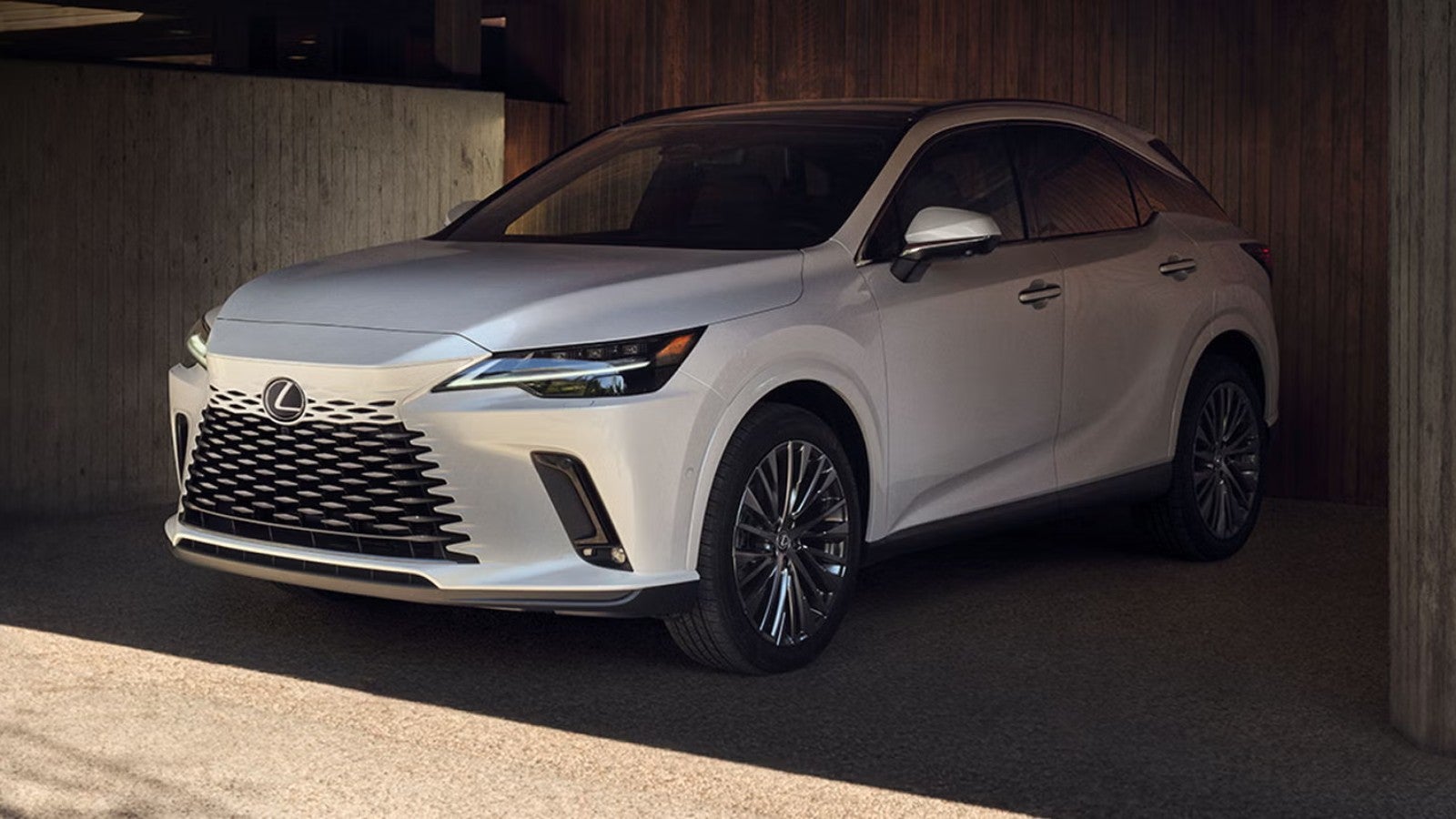
The 2027 Lexus RX 350h vs RX 450h+ decision comes down to one question: do you want to plug in? With the RX 350h, you fuel it and drive, and no outlet is involved. The RX 450h+ is a plug-in hybrid, and regular charging gets you a lot of electric driving. Both are AWD SUVs, so the right pick depends on your routine and not on which one is "better."
If you're shopping around San Jose, you can browse new vehicles as you read. We'll walk through performance, range, and charging in plain language, then get to the grades.
2027 Lexus RX 350h vs. RX 450h+ at a Glance
Think of this as a habits question. The RX 350h gives you hybrid efficiency with no charging in your routine. The RX 450h+ adds rechargeable electric driving for shorter trips and keeps hybrid technology for longer journeys, which is how Lexus positions it.
This table lines up the confirmed 2027 figures for both models. Fuel economy figures are manufacturer estimates.
| Feature | RX 350h | RX 450h+ |
|---|---|---|
| Powertrain | 2.5L four-cylinder hybrid | 2.5L four-cylinder plug-in hybrid |
| Combined system output | 246 hp, 233 lb-ft | 304 hp |
| 0–60 mph | 7.4 seconds | 6.2 seconds |
| Drivetrain | Electric AWD (rear motor) | Electric AWD (rear motor) |
| Transmission | CVT | CVT |
| Fuel economy (manufacturer-estimated) | 37 city / 34 hwy / 36 combined mpg | 36 city / 33 hwy / 35 combined mpg (gas only) |
| Electric range | N/A (not a plug-in) | 38 miles, EPA-estimated |
| Battery | Nickel-metal hydride | Lithium-ion |
| Fuel tank | 17.17 gal | 14.53 gal |
| Towing (braked) | 3,500 lbs | 3,500 lbs |
| Cargo | 29.59 cu ft; 46.19 cu ft max | 29.59 cu ft; 46.19 cu ft max |
| Standard safety | Lexus Safety System+ 3.0 | Lexus Safety System+ 3.0 |
The RX 450h+ gives up one mpg on gasoline and gains about 58 horsepower plus a meaningful electric range. Extra power and potential fuel savings are two different benefits, and some buyers only want one of them.
Powertrain and Performance: Standard Hybrid vs. Plug-In Hybrid
Both models pair a 2.5L four-cylinder engine with electric motors and a CVT, which delivers power smoothly instead of in stepped shifts. The battery and how it gets its energy are what differ. If you’re weighing other options, explore the full lineup of Lexus electrified vehicles, from hybrids to all-electric models.
RX 350h: Self-Charging Hybrid Operation
"Self-charging" simply means a hybrid you never plug in. The system coordinates the gasoline engine and electric motors automatically, so nothing about your routine changes.
The RX 350h makes 246 system horsepower and 233 lb.-ft. of torque, and it reaches 60 mph in 7.4 seconds. That's brisk for daily driving. You fill up and go.
RX 450h+: Plug-In Hybrid Power and Electric Driving
The RX 450h+ carries a high-capacity lithium-ion battery that you recharge externally. That larger battery supports sustained electric driving, which is different from the brief, condition-dependent electric operation of a conventional hybrid. It also feeds a 304 net combined horsepower output and a 0-60 mph time of 6.2 seconds.
A strong hybrid-system output says little about how the car performs on electric power alone. Electric operation varies with how hard you drive, the temperature, and what the system needs, so the engine may join in at times.
AWD and Driving Feel
Both models come standard with electric all-wheel drive. Each places a dedicated electric motor at the rear axle, which can send power to the rear wheels almost instantly when the front tires lose grip or when you accelerate hard. On the RX 450h+, the system’s added electric output also helps deliver its quicker 6.2-second 0–60 mph time.
AWD helps with traction, but grip and stopping distance are another matter, so tires, weather, and your inputs still count. When you test drive both, pay attention to throttle response, engine sound under acceleration, ride comfort, and how smoothly the car moves between electric and gasoline operation.
Fuel Economy, Electric Range and Charging
Fuel economy is where the two models separate most. The RX 350h has one set of numbers. The RX 450h+ has three that measure different things, so it helps to keep them apart.
MPG vs. MPGe and Total Driving Range
MPG is the distance you travel per gallon of gasoline, while MPGe is an energy-equivalence measure that compares electric energy use with gasoline. The RX 450h+ is rated at 85 MPGe combined while running on battery power, and once the charge is used, Lexus estimates 35 mpg combined on gasoline.
The RX 350h earns a manufacturer-estimated 36 mpg combined, while the RX 450h+ offers an EPA-estimated 38 miles of electric-only range. Keep the fuel tanks in mind for longer trips, too: the RX 350h carries 17.17 gallons to the RX 450h+’s 14.53, so the hybrid goes farther between fill-ups once the plug-in’s battery is depleted. Real-world electric range varies with temperature, speed, hills, load and climate-control use, so treat 38 miles as a best-case planning figure.
Charging the RX 450h+ at Home and in Public
Level 1 charging uses a standard household outlet and is slow. Level 2 uses a 240V circuit and is much faster. The RX 450h+ comes with a standard dual-voltage cable for 120V and 240V outlets, a J1772 (Type 1) socket, and a 6.6 kW onboard charger.
Lexus estimates a full charge in approximately two-and-a-half hours at 240V, maximum current, and ideal conditions. For most owners, overnight Level 2 charging at home is the practical option, and public charging is optional. Before relying on home charging, have a qualified electrician check your outlet and circuit capacity. If you share a charger or use public stations, verify compatibility and speed first.
What Happens When the Plug-In Battery Runs Low
The RX 450h+ pairs a gasoline engine with its battery and offers hybrid technology for longer journeys, so range anxiety isn't a factor as long as there's gas in the tank. A low electric-range reading doesn't mean you're out of power.
Charging when it's convenient adds electric miles. Your operating costs will depend on how often you plug in, local electricity and gasoline prices, and how much of your driving is electric.
Not sure which fits your commute? Contact us and we'll help match a powertrain to your routine.
Features, Grades and Practicality
The RX character carries across both models, and the gap between them is narrower than you might expect. Grades and charging logistics are where they actually differ.
What Both Powertrains Share
Both seat five and offer 29.59 cu ft of cargo space behind the rear seats, or 46.19 cu ft with the seats folded, and both can tow up to 3,500 lbs, enough for a small boat or a pair of jet skis. On the Premium grade, a 9.8-inch touchscreen is standard with a 14-inch display available, while the 14-inch screen comes standard on the Premium+ and Luxury. Wireless Apple CarPlay and Android Auto, a wireless phone charger and a 12-speaker Lexus premium sound system are standard on every grade, so the 2027 RX interior feels familiar either way.
Lexus Safety System+ 3.0 is standard, including Pre-Collision System with Pedestrian Detection, Full-Speed Range Dynamic Radar Cruise Control, Lane Tracing Assist, Road Sign Assist, Automatic High Beams, and Proactive Driving Assist. Blind Spot Monitor with Rear Cross-Traffic Alert and Intuitive Parking Assist with Auto Braking are also standard. These systems assist you, and they still need your attention.
If you're leaning toward the RX 450h+, add one practical item to the list: where the charging cable lives and where you'll park to charge.
Grade Availability: Not Every Grade Comes with Both Powertrains
The 2027 RX comes in six grades: Premium, Premium+, Luxury, F SPORT Handling, F SPORT Performance, and F SPORT Design. The powertrains don't line up across all of them.
RX 350h: Premium, Premium+, Luxury, and F SPORT Design
RX 450h+: Premium and Luxury only
If you want a sportier look, the RX 350h in F SPORT Design is the hybrid option. Our team can confirm which grade and powertrain combination suits you. The RX 450h+ costs more upfront and benefits most from regular charging, so compare similarly equipped vehicles when weighing the difference.
Which RX Suits Your Bay Area Driving?
In San Jose and across Silicon Valley, the right answer depends on your daily miles, whether you have charger access, and how much of your driving is on the freeway. Browse new Lexus SUVs in stock to see what's currently available.
Choose the RX 350h If You Drive Freeway Miles or Can't Plug In
If your week involves long stretches of I-280, US-101, or I-880, say a drive between Fremont and Santa Clara or Hayward and Santa Clara, the RX 350h keeps things simple. You get hybrid efficiency, and charging never becomes a chore.
It also suits anyone in a building without a dependable charger, since nearby public charging doesn’t mean you can count on it when you need it. For weekend drives over Highway 17 to Santa Cruz or longer trips to Tahoe, the RX 350h handles them like any gasoline SUV, and its larger 17.17-gallon tank means fewer fuel stops along the way.
Choose the RX 450h+ If You Have Home Charging and Short Commutes
If you live near work, say a Cupertino to San Jose commute, and can plug in overnight, the RX 450h+ lets much of your routine run on electricity. Compare your actual round-trip mileage with a realistic electric range, and allow for hills, higher speeds, and heating or air conditioning.
Freeway use alone doesn't rule out the RX 450h+. It just reduces how much of your driving is electric. Either powertrain handles longer trips without mandatory charging stops, and the RX 450h+ also lets you recharge when it suits you. Our service department can support hybrid and plug-in maintenance after you buy.
Shop Lexus RX Inventory at Lexus Stevens Creek
The best way to choose between the RX 350h and RX 450h+ is to drive them back to back. Shop our Lexus RX inventory to compare models by powertrain and grade, then schedule a test drive on I-280 to feel the RX 450h+’s quiet electric acceleration and the RX 350h’s seamless hybrid efficiency for yourself. Our team can also walk you through home charging and financing options to help you find the right RX.
Visit us at 3333 Stevens Creek Blvd. in San Jose, Monday through Saturday from 9 a.m. to 8 p.m. and Sunday from 10 a.m. to 7 p.m., or call sales at 408-878-4112.