

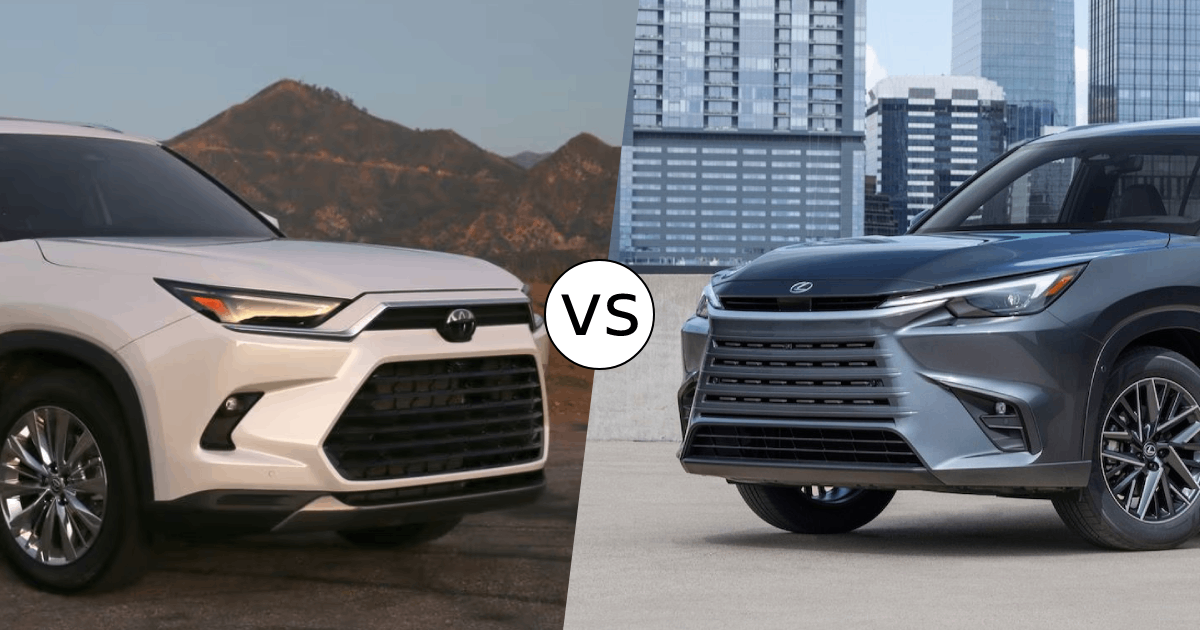
If you’re looking for a three-row SUV that fits your family’s daily routine while giving you space and dependability, then the 2025 Lexus TX and Toyota Grand Highlander are two great choices. They are more related than you’d think, though aimed at different buyers. Both offer families plenty of room and modern technology, but weighing up the differences in luxury levels and price tags involves more than just simple preferences. Let our team at Lexus Stevens Creek help you decide which to choose with this full Grand Highlander versus Lexus TX comparison.
Two Premium Three-Row SUVs: Understanding the Lexus-Toyota Connection
Both SUVs share the GA-K platform and the basic mechanical parts that Toyota has perfected over time. They use a turbocharged 2.4-liter four-cylinder engine instead of a V-6 and can tow up to 5,000 pounds when properly equipped. Beyond these shared foundations, they focus on different buyer segments.
The Lexus TX targets luxury buyers seeking premium materials and refined driving, while the Grand Highlander is built for practical shoppers who prioritize value over luxury touches. That’s why people call the Grand Highlander the “Lexus TX Toyota equivalent” when they want similar capability without luxury pricing.
The 2025 Lexus TX measures 203.1 inches, compared with the Grand Highlander’s 201.4 inches, and both share a 116.1-inch wheelbase. Toyota’s feature upgrades are closing the gap between brands, as the Grand Highlander now includes standard equipment that used to be luxury-only.
Pricing and Value: Premium Versus Practical Positioning
Price differences will play a significant part when you’re considering the Grand Highlander versus the Lexus TX. The basic 2025 Grand Highlander starts at $40,860, while the cheapest TX costs $55,140 — that’s $14,000 more for the Lexus badge, premium materials, and luxury positioning.
Hybrid versions widen the gap further. The Grand Highlander Hybrid starts at $44,210, compared to the TX hybrid at $68,660. The Grand Highlander’s price includes standard all-wheel drive (AWD), delivering strong value. The top Lexus TX 550h+ Luxury AWD costs $77,210.
The top Grand Highlander MAX Platinum costs $58,775, roughly $20,000 less than comparable Lexus models. If you’re like most Silicon Valley families and are facing high household bills, that difference could be significant.
Performance and Powertrains: More Different Than You’d Expect
Despite shared platforms, engine tuning differs notably. Toyota’s gas engine produces 265 horsepower and 310 lb-ft of torque; the Lexus exceeds this with 275 horsepower and 317 lb-ft of torque. The TX 350 achieves 21 mpg in the city and 27 mpg on the highway, while the Grand Highlander delivers 21 mpg in the city and 28 mpg on the highway.
Hybrid versions show bigger gaps. The TX500h F Sport Performance combines a turbo 2.4-liter with two electric motors for 366 horsepower. The Grand Highlander Hybrid Max delivers a nearly identical 362 horsepower. Toyota offers a nonturbo 245-horsepower hybrid as its entry-level option.
Lexus dominates with plug-in capability. The TX 550h F Sport uses a 3.5-liter V-6 engine with two electric motors and an 18.1 kWh battery pack. The motors produce 101 horsepower and 179 horsepower, respectively, for a combined system output of 404 horsepower and 33 miles of electric range. If you’re a San Jose commuter, you can drive each day electrically while maintaining a gas backup for longer trips.
Fuel Economy and Efficiency: Hybrid Technology Face-Off
Gas mileage matters a lot to Bay Area families. Both SUVs are relatively fuel-efficient, but their hybrid systems operate differently. The Grand Highlander’s basic 245-horsepower hybrid delivers good efficiency without complex turbo parts, while the stronger hybrid versions deliver similar real-world miles per gallon despite their extra power.
The Lexus TX 550h F Sport achieves around 29 mpg combined, which increases to 76 MPGe when running on electricity. It doesn’t support DC fast charging, but can be fully charged on a Level 2 home charger in three hours. If you have home charging in a place such as Palo Alto, most daily drives can be completed using zero gas.
The Grand Highlander Hybrid Max has plenty of power for passing slower traffic on I-280 or I-101. It has a towing capacity of 5,000 pounds and delivers 27 mpg combined in everyday driving. This balance of efficiency and lower purchase price makes it attractive if you want hybrid perks without the extra cost of plug-in systems.
Interior Space and Seating: Comfort Meets Practicality
There’s not much difference when you’re comparing the Lexus TX versus Grand Highlander dimensions: headroom, legroom, and hip room are all similar. There are differences in seating capacity, though. The Grand Highlander seats eight with bench seats in the second and third rows, while the Lexus TX comes as a six- or seven-seater with comfortable captain’s chairs.
The Grand Highlander’s cabin is roomy, but the craftsmanship and overall atmosphere of the Lexus interior make a stronger impression, yet many drivers find the Grand Highlander seats just as comfortable.
Lexus includes fancier touches even in its cheapest version, with digital gauges, mood lighting, and NuLuxe seats all standard. But Toyota’s not far behind, with heated front seats, multizone climate control, and wireless phone connectivity even in its most basic trim, demonstrating Toyota’s competitive edge.
Technology and Infotainment: Premium Features Versus Value
Technology differences highlight each SUV’s market position. The 2025 Lexus TX Hybrid comes with a 14-inch touch-screen display plus a 12.3-inch digital gauge cluster, with an optional head-up display. You get wireless Apple CarPlay and Android Auto, a Wi-Fi hot spot function, and a 12-speaker sound system that can be upgraded to a 21-speaker Mark Levinson system if you’re an audio buff.
The Grand Highlander takes a more practical approach to technology. It has a 12.3-inch touch screen, while XLE models use a 7-inch digital display. The Limited and Platinum versions feature a 12.3-inch gauge display that closely matches what Lexus offers. Toyota includes all the connectivity most families need, with JBL premium speakers available for better sound.
Both systems work well from day to day, though the Lexus interface feels slicker and quicker to respond. If you’re technology-savvy, either SUV provides phone integration and connectivity that makes life easier, but Lexus adds luxury touches, including bigger screens and better audio, which partly justify its higher price.
Choose Your Premium Three-Row SUV Wisely
The Grand Highlander offers excellent value if you require reliable three-row transportation without luxury costs. The Lexus TX is a better fit if you want premium materials and a sense of luxury; it costs less than many European luxury SUVs while providing Toyota reliability. The plug-in hybrid works perfectly if you’re an eco-conscious buyer. Contact our team at Lexus Stevens Creek to arrange a test-drive of the 2025 Lexus TX to help you decide whether its premium features justify the investment.
Connect with us


